RAID vs Cloud Storage Resilience
Why RAID Is Not Enough for Modern Cloud Architecture
Introduction
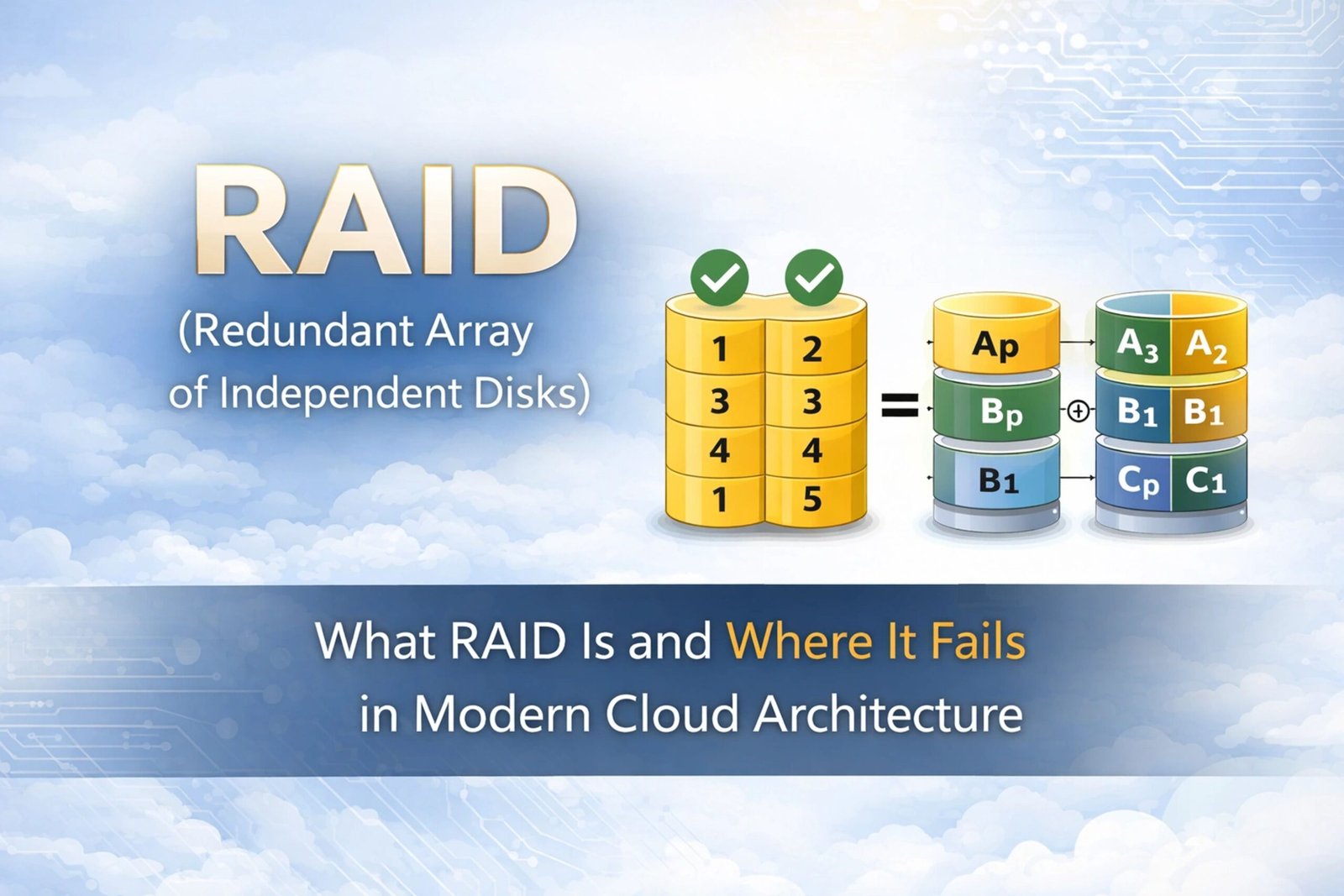
For decades, RAID (Redundant Array of Independent Disks) has been the foundation of enterprise storage fault tolerance. It protects against disk failure using mirroring and parity techniques.
However, in modern cloud environments — Just RAID alone is not sufficient.
Today’s cloud architectures are built on:
- Distributed storage
- Fault Domains
- Availability Domains
- Cross-region replication
- Software-defined infrastructure
This article explains:
- What RAID actually protects
- How XOR-based parity works
- Why RAID is limited
- How OCI achieves architectural resilience
- A technical comparison of OCI AD vs AWS AZ
- What modern cloud providers actually use
What RAID Really Does
RAID combines multiple disks into one logical unit to provide:
- Hardware-level redundancy
- Performance improvement
- Storage efficiency
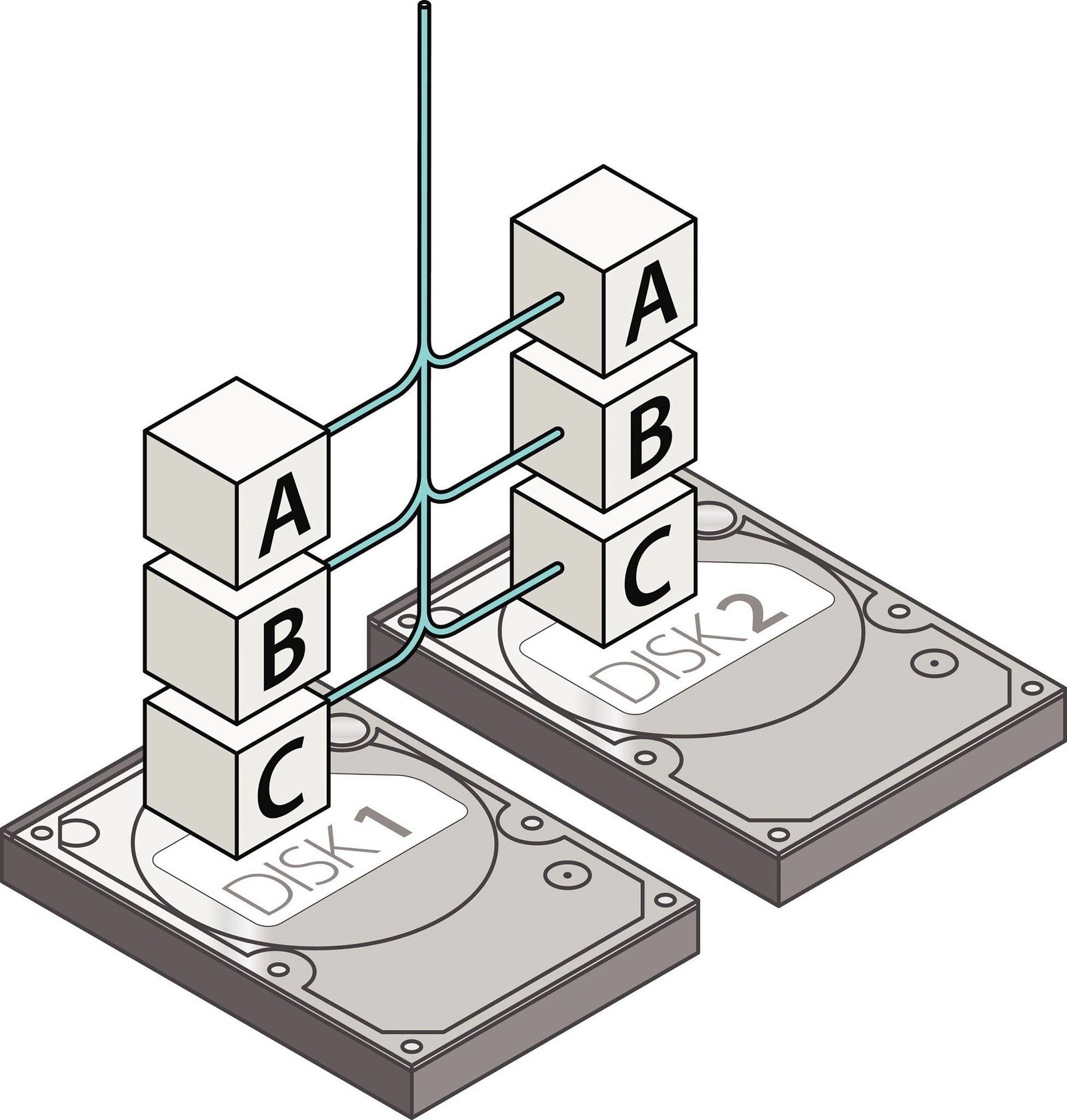
RAID 1 – Mirroring
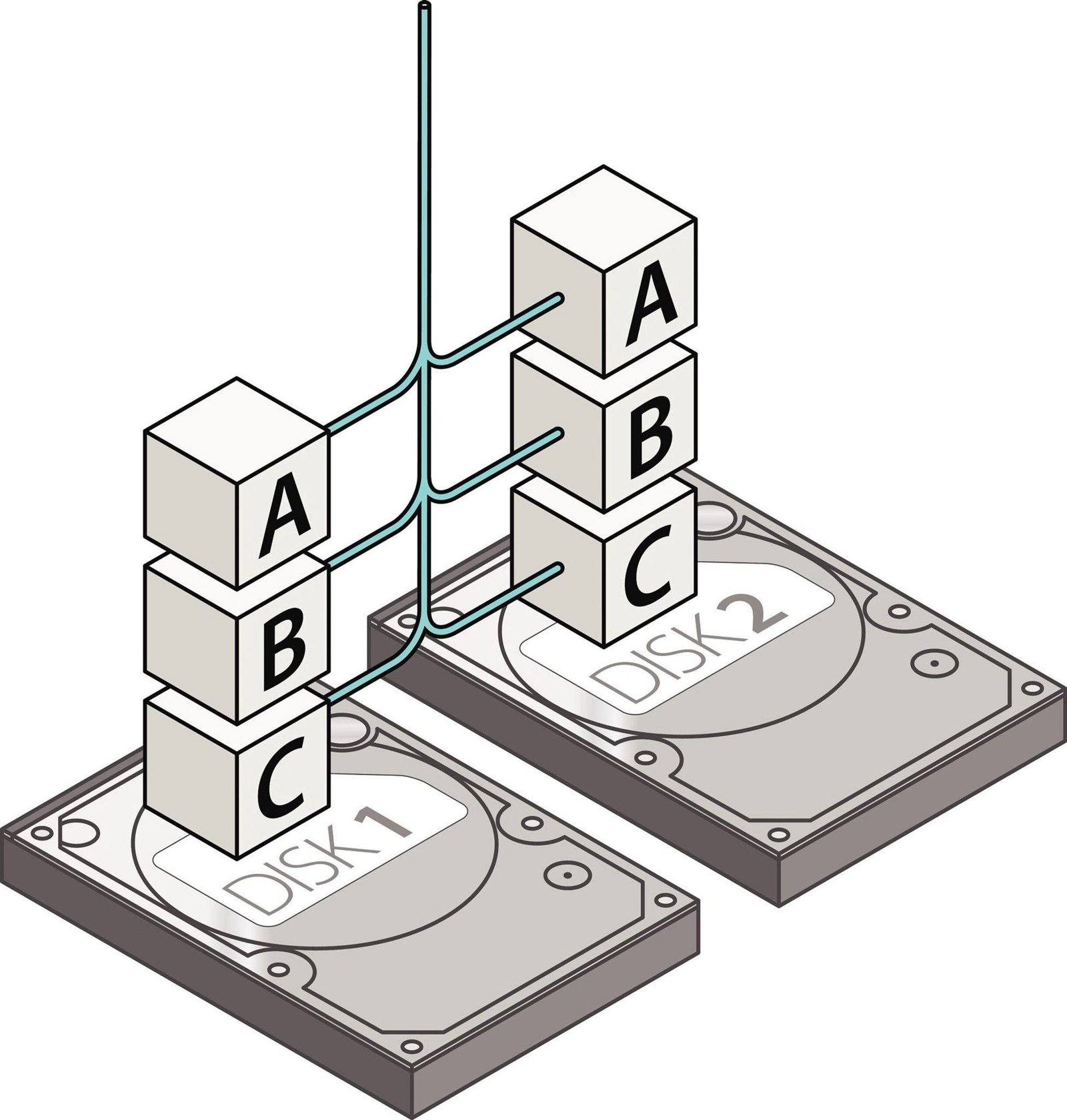
- Data duplicated across disks
- Survives one disk failure
- 50% storage efficiency
Simple and reliable — but limited to disk failure protection.
RAID 5 – Distributed Parity
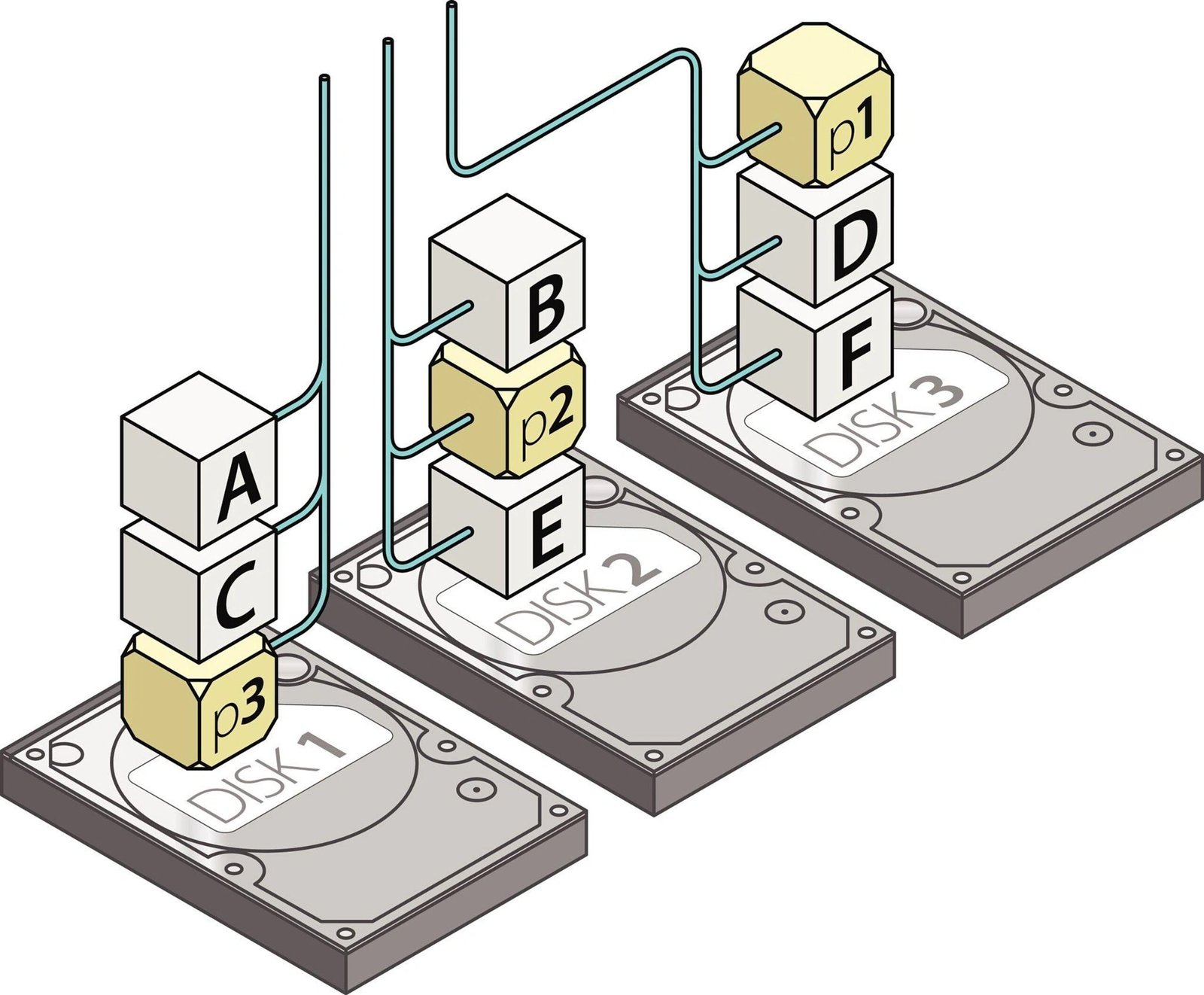
- Block-level striping
- Parity calculated using XOR
- Parity rotates across disks
- Survives one disk failure
More efficient than RAID 1, but parity calculations affect write performance.
How XOR Parity Actually Works –
XOR Rule
If bits are DIFFERENT → result = 1
If bits are SAME → result = 0
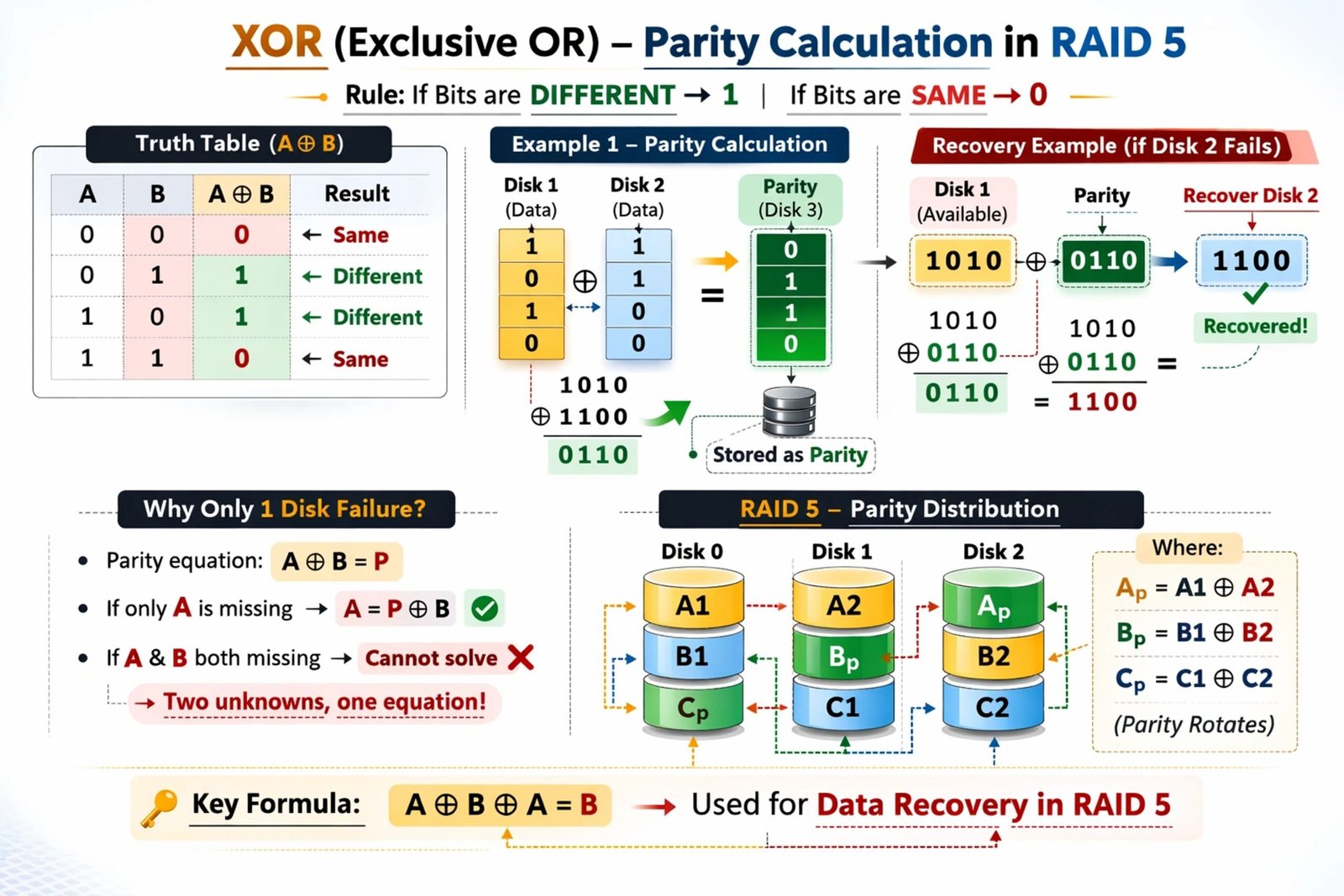
Example 1 – Binary Block Example
Disk 1: 1010Disk 2:
1100
Parity calculation:
 1010

⊕1100

--------

 0110
Parity = 0110
Stored on third disk.
Recovery Example
If Disk 2 fails:
We have:
Disk1 = 1010

Parity = 0110
To recover Disk 2:
Recovered = Disk1 ⊕ Parity
1010

0110

--------

1100
Recovered successfully.
Because:
A ⊕ B ⊕ A = B
This mathematical property enables RAID 5 recovery.
Why RAID 5 Tolerates Only One Disk Failure
If two disks fail:
You would have two unknown values.
One equation (parity) cannot solve two unknowns.
That is why RAID 5 tolerates only one disk failure.
What RAID Does NOT Protect Against
Even with XOR parity, RAID does NOT protect against:
- Server failure
- Rack failure
- Power outage
- Data center fire
- Availability Zone failure
- Region outage
- Accidental deletion
RAID = disk protection only.
How Oracle Cloud Infrastructure (OCI) Achieves Resilience
In Oracle Cloud Infrastructure, resilience is layered.
Protection levels include:
- Disk
- Server
- Fault Domain
- Availability Domain
- Region
OCI Fault Domains (FD)
A Fault Domain is:
- A grouping of hardware inside an Availability Domain
- Separate power distribution
- Separate network paths
- Separate racks
Deploying across FDs protects against:
- Rack-level failure
- Hardware cluster failure
OCI Availability Domains (AD)
An Availability Domain is:
- One or more physically separated data centers
- Independent power
- Independent cooling
- Independent networking
Failure of one AD does not affect others.
This is architectural isolation.
OCI Storage Services and Durability
OCI Block Volume
- Replicated within Availability Domain
- Designed assuming disk failure is normal
- High durability and performance
OCI Object Storage
- Replicated across Fault Domains
- Optional cross-region replication
- Extremely high durability
Comparison of Major Cloud Providers
Cloud providers including:
- Amazon Web Services
- Microsoft Azure
- Google Cloud
- Oracle Cloud Infrastructure
achieve durability through:
- Replication
- Erasure coding
- Multi-AZ / Multi-AD deployment
- Cross-region architecture
- Not just RAID.
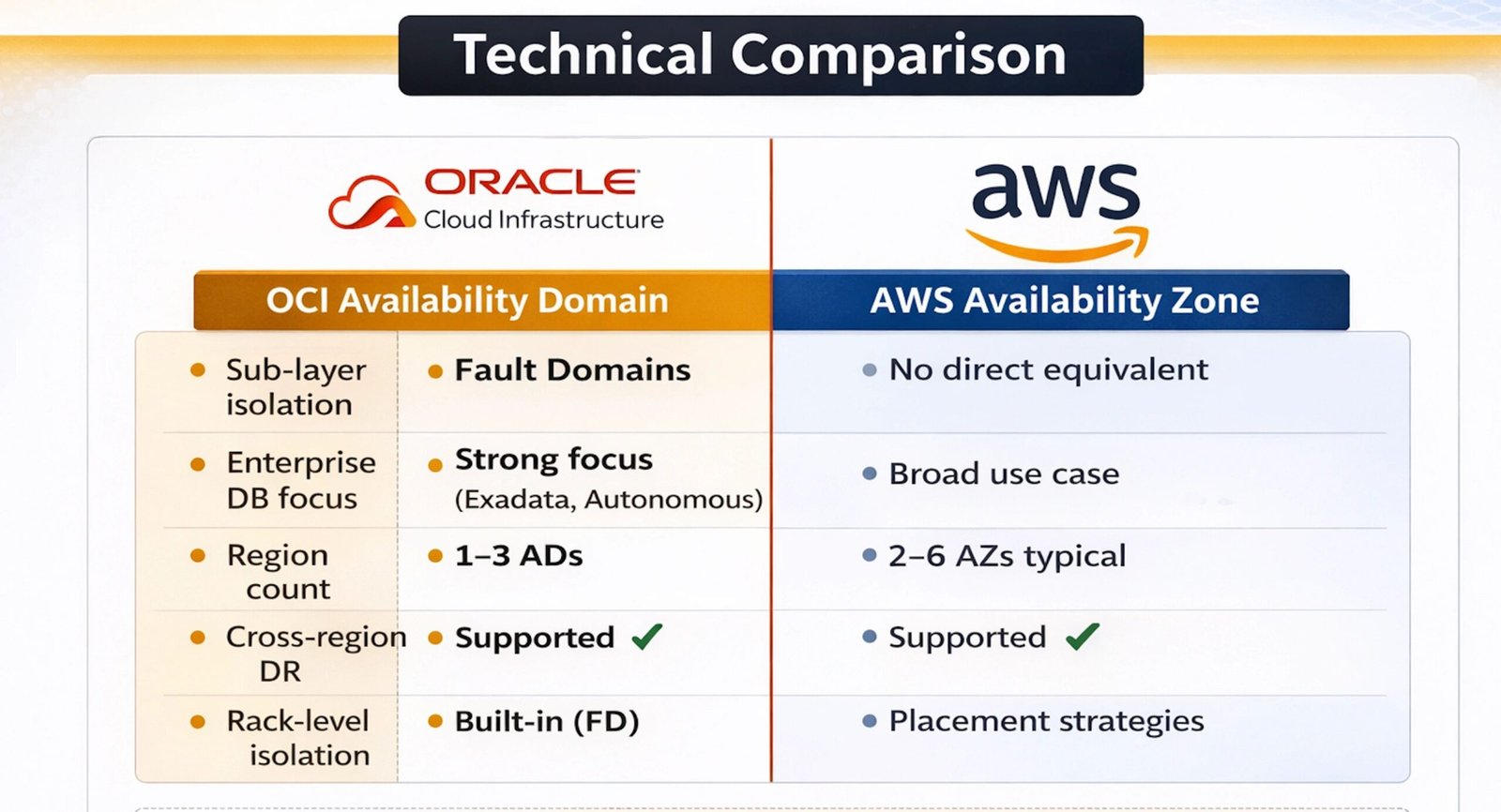
OCI Availability Domain vs AWS Availability Zone (Technical Detail)
OCI Availability Domain (AD)
- Region may contain 1–3 ADs
- Each AD contains multiple Fault Domains
- Physical isolation
- Strong enterprise database focus (Autonomous, Exadata)
Deployment best practice:
- Spread across Fault Domains
- Spread across Availability Domains
- Enable cross-region replication for DR
AWS Availability Zone (AZ)
- Region contains multiple AZs
- Independent infrastructure
- No direct Fault Domain equivalent
- Deployment across AZs required for HA
Key Takeaway
XOR-based parity in RAID 5 is elegant and powerful.
But RAID protects disks — not systems.
In modern enterprise cloud design, especially within Oracle Cloud Infrastructure, resilience must be:
- Fault Domain aware
- Availability Domain aware
- Region aware
The modern resilience question is not:
“Will my disk survive?”
The real question is:
“Will my architecture survive?”